What the platform delivers
ForgeIEC is a complete platform for industrial automation — from programming to operation. Current state: preview version 0.2 (0.2.2), in pilot operation at the SoLaWi Ackervielfalt. Every component carries the name of a blacksmith’s tool and has a clearly defined remit. Components are standalone daemons or applications, jointly running over zero-copy IPC and gRPC.
| Component | Remit | Status | |
|---|---|---|---|
 | ForgeIEC Studio | IEC 61131-3 IDE + bus config + AI assistant | ST editor in use, LD/FBD/SFC planned: 0.3/0.4/0.5 |
 | Anvil server (anvild) | PLC runtime + Anvil bus (iceoryx2) between the processes | in use |
| tongs-* | Fieldbus bridges: Modbus TCP/RTU available, LoRaWAN in progress (focus), EtherCAT / PROFIBUS / EtherNet/IP as skeleton | mixed | |
| Hearth | Operator interface (HMI), reads process data directly from the Anvil bus | preview | |
| Screen | Industrial kiosk browser (HMI panel) | available as package | |
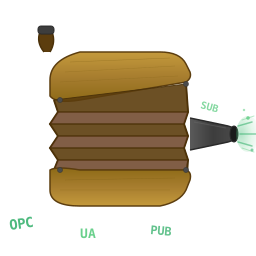 | bellowsd | OPC-UA / HMI gateway | resting — not in development |
| Ledger | Order management / MES integration | planned |
The components
🛠️ ForgeIEC Studio — the workbench
Native C++/Qt6 IDE on the workstation (Linux; a Windows build exists, installer on request). Structured Text (ST) with an own, object-oriented-capable compiler core is in use; LD, FBD and SFC are planned for releases 0.3, 0.4 and 0.5 (roadmap), IL is deprecated. Bus configuration, live monitor, oscilloscope, AI assistant built in. Tree-sitter syntax, gRPC link to anvild, MCP server for LLM tooling.
🔥 Anvil server (anvild) — the runtime + Anvil bus
Rust/Tokio daemon on the target PLC. Multi-task scheduler with pthread parallelism, deterministic scan cycles, gRPC listener for Studio, subprocess manager for the bus bridges.
Built in is Anvil — the Anvil bus, a zero-copy shared-memory layer based on iceoryx2, between runtime, bridges and external subscribers. ABI probe against type-hash drift; segments of crashed peers are reaped automatically, without touching live peers. Wire protocol for status, I/O, diagnostics.
🌬️ bellowsd — the bellows
Resting
bellowsd is currently not in development. The packageforgeiec-bellows-server stays in the APT repository but is not
being developed further. Hearth is the intended operator interface.Designed as an OPC-UA server + Modbus TCP server for HMI
integration: pool variables with the bellows_export flag as OPC-UA
nodes + Modbus coils, enabled individually per variable.
🔧 tongs-* — the fieldbus tongs
One daemon per protocol. Uniform fault model
(OK/WARN/FAULT/OFFLINE/UNKNOWN), FDD-driven diagnostic bits,
Anvil zero-copy IPC to the runtime. Modbus TCP and Modbus RTU are
available; LoRaWAN (wireless sensors for agriculture and wide-area
plants) is in progress and has priority; for EtherCAT, PROFIBUS and
EtherNet/IP the skeleton exists, the protocol itself is in progress.
🖥️ Screen — the kiosk browser
CEF-based industrial kiosk browser (Chromium Embedded Framework
- Rust + winit). Runs fullscreen on HMI panels, opens any web HMI (Hearth or third-party). Integrated Rocket web server for settings (network, WireGuard, time zone, 80+ languages), D-Bus backend for NetworkManager / timedated / localed.
🏠 Hearth — the forge hearth
Operator interface (HMI), as a preview. Hearth reads the process
data directly from the Anvil bus (iceoryx2, without copying) — the
same path the runtime uses internally; anvild writes the matching
descriptor to /etc/forgeiec/hearth/descriptor.toml. Available as
the forgeiec-hearth-server package in the APT and RPM repositories.
📒 Ledger — the order book
Order management + MES integration. Plans: production orders, piece-count tracking, traceability (material → batch → product), shift log, bridge to ERP systems. Planned — comes after Hearth.
How the components fit together
flowchart LR
    Studio[ForgeIEC Studio<br/>IDE + AI]
    Anvild[Anvil server<br/>anvild]
    Bridges["tongs-*<br/>Fieldbus bridges"]
    Screen[Screen<br/>Kiosk browser]
    Hearth[Hearth<br/>HMI, preview]
    Ledger[Ledger<br/>MES]

    Studio -.->|gRPC| Anvild
    Anvild -->|Anvil IPC| Bridges
    Anvild -->|Anvil IPC| Hearth
    Hearth -->|HTTP| Screen
    Hearth -.->|REST| Ledger
Studio lives on the workstation, everything else on the target systems. Workstations + target systems can be linked together via the team federation model — multiple workstations see their machines.
Licence, source code and origin
Licence. The ForgeIEC tools and services are licensed under AGPL-3.0-or-later. Your project belongs to you: the generated control code, the runtime API headers and the libanvil library are licensed under Apache-2.0 — you may build your own closed libraries on top. If you cannot accept the AGPL, you can obtain a commercial licence.
The source code is under the AGPL; access on request (enabled via SSH key, see Partner). Delivery is through signed packages from an automated CI: a signed APT repository for Debian/Ubuntu and a signed RPM repository for AlmaLinux 9 and Fedora 44.
ForgeIEC started as a fork of OpenPLC (Thiago Alves); the matiec compiler was replaced by an own, object-oriented-capable core. The founding story tells the path.
The tools of the forge.