Partners
Partnership at ForgeIEC
ForgeIEC is an open-source project built on the conviction that industrial automation must be accessible to everyone. We are looking for partners who share this vision and are ready to actively shape the future of automation.
Our source repositories
ForgeIEC is mirrored on GitHub and Forgejo
(git.forgeiec.io). Applicants can review the code base before
applying, and the ★ count on GitHub gives a first impression of
the community attention.
| Repository | What’s inside | GitHub | Forgejo |
|---|---|---|---|
| ForgeIEC-Studio | C++/Qt6 IDE + bus config + MCP server |  | git.forgeiec.io/ForgeIEC/forgeiec-studio |
| anvil-server | Rust/Tokio PLC runtime + bridge subprocess manager |  | git.forgeiec.io/ForgeIEC/anvil |
| bellows-server | OPC-UA / HMI gateway |  | git.forgeiec.io/ForgeIEC/bellows |
| forgeiec-website | Hugo site you’re reading right now |  | git.forgeiec.io/ForgeIEC/forgeiec-website |
Each repo contains its own documentation/architecture/
sub-directory or spec collection — anyone wanting to dive deeper
finds the normative RFC 2119 specs at full length.
Requirements
Proven open-source engagement
Applicants must already have demonstrated that they support the idea of open source. That means:
- Demonstrable contributions to existing open-source projects (commits, pull requests, bug reports, documentation)
- Public profile on platforms such as GitHub, GitLab, or Codeberg
- Active participation in open-source communities — not just use but co-creation
We believe actions speak louder than words. Whoever sees open source merely as a marketing instrument without contributing themselves does not fit our philosophy.
Shared values
- Transparency — open communication, traceable decisions
- Collaboration — code reviews, shared architecture discussions, knowledge sharing
- Quality — documented tests, clean code, industrial-grade reliability
- Long-term thinking — partnership is not a sprint but a marathon
Areas where we are looking for contributors
If the requirements above fit you — these are the subsystems where we are particularly looking for fellow builders:
🔧 Bus bridges (tongs-*)

- tongs-ethercat — DC sync, slave state machine, ENI XML import
- tongs-profibus — DP master, GSD import toolchain
- tongs-ethernetip — CIP connections, EDS import
- tongs-can — CANopen + J1939
Skeleton + fault model + IPC wire format are in place — the protocol-specific part is missing.
🛠️ Studio editor features

- FBD/LD/SFC editors — today the focus is on ST. Graphical languages need their own tree-sitter grammars + canvas renderers.
- Vendor catalog — FDDs for more manufacturers (today: Weidmueller). GSDML/EDS/ESI converters welcome.
- Internationalisation — Studio + website are translated into EN/DE/FR/ES/ZH/JA/TR/AR; some languages are only machine pre-filled.
🌬️ HMI integration (bellowsd)
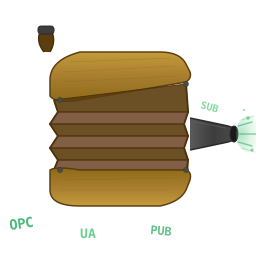
- OPC-UA companion specs — bellowsd today supports generic OPC-UA nodes. Companion-spec adapters (e.g. PackML, OPC-UA Robotics) welcome.
- HMI frameworks —
Hearthis planned as the IIoT subscriber layer. If you work with MQTT, time-series DBs (InfluxDB, TimescaleDB) or Grafana pipelines, you can help shape the architecture here.
🔥 Runtime + determinism (anvild)
- Real-time Linux tuning — PREEMPT_RT kernel, CPU pinning, cache locality for sub-millisecond cycle times
- Rust+LLVM codegen (rusty) — planned migration of the layer-1 codegen away from matiec/C output to Rust+LLVM. Determinism guarantees + online-change preparation.
- Hardware targets — Raspberry Pi, BeagleBone, industrial x86, ARM SBCs.
📚 Education + documentation
- Tutorials — from “first Knight Rider in 5 minutes” to “complete machine control with OPC-UA + EtherCAT”
- Example projects — today only 2 demos live in the tree
- Teaching curriculum — universities wanting to use ForgeIEC as a teaching IDE. We deliver Studio for free; lecturers bring the IEC curriculum.
What we offer
Access to the ForgeIEC platform
- Early access to new features and development branches
- Direct line to the core team
- Possibility to actively shape the roadmap
Joint development
- Shared work on industrial fieldbus drivers
- Integration of vendor-specific hardware
- Development of industry-specific extensions
Technical support
- Prioritised bug fixing
- Architecture advice for own extensions
- Help integrating into existing systems
Forms of partnership
Technology partner
Manufacturers of automation components who want to integrate their hardware in ForgeIEC. Joint driver development, device configurations, and test procedures.
Integration partner
Systems integrators and engineering offices that use ForgeIEC in customer projects. Practical knowledge flows back into the development.
Education partner
Universities and training institutions that use ForgeIEC in teaching. Free access for the education sector — the next generation of automation engineers should learn with open tools.
Currently registered partners
As of 2026-05: no external partners yet — the platform is in build-up sprint, partner onboarding begins once the first subsystem APIs (bridge SDK, FDD format) stabilise.
If you want to be among the first: see “How to apply” below.
How to apply
You would like to become a partner? Write to us with:
- Description of your organisation
- Links to your open-source contributions
- Your motivation for a partnership
- Specific area where you would like to contribute
Together we forge the tools of the future.